
A number of candidates have now released tax plans. Most recently Bush has proposed cutting the top income tax down to the his-father-had-doubts level of 28 percent. Rubio wants a nearly-universal basic income with work requirements. Rand Paul wants the so-called "Flat Tax," and while Huckabee has said little he is a long-time advocate of the "Fair Tax." Apparently you can now get taken seriously while proposing extraordinarily radical tax plans with phony-baloney numbers that have no relationship to the actual budget, so I figured I'd give it a shot. Here's what a radical technocrat might propose.
- Abolish payroll taxes
- Abolish joint marriage tax filing
- Abolish all deductions: mortgage income, charitable, standard, maybe ESI
- Abolish corporate tax
- Abolish all tax-deductible dedicated savings accounts (health, education, 401k accounts). See capital gains tax below.
- Abolish estate tax. See capital gains tax below.
- New income tax:
$0-$15,000 -30% $15,000-$75,000 0% $75,000-$400,000 30% $400,000+ 60% - New capital gains tax:
Everyone gets one capital-tax-exempt savings account with value capped at $5 million. 0% taxes on all income from the savings account, 60% tax on all other non-labor income.
Ok, some points here need to be elaborated.
Here's how that negative income tax works
For each dollar less than $15,000 in labor income an individual makes, they'd receive a $0.30 subsidy from the government. So if you have no income, you get $5,000 a year. Importantly, everyone is an individual tax filer under this plan, so if you have three non-working children, that's $15,000 a year in support. By and large, the vast majority of welfare under this plan goes to children. Notice that the plan virtually eliminates poverty among workers: for a single Mom with three kids working full time at minimum wage that's $14,500 in income plus her own $150 subsidy, plus $15,000 for the kids, for a total income of $29,650, well above poverty level. Since most of our means-tested welfare goes to children, and this plan would cause them to exceed the means-test limits, there are substantial offsetting spending reductions here.
Nothing could be simpler
Without deductions (not even a standard deduction!), marriage filing, tax credits, payroll taxes, or (for most people) capital gains, filing taxes would be simple. Most people wouldn't have to do it.
Special note about ESI tax-exclusion
While it is popular in the health econ world to support ending the tax-exclusion for employer-sponsored health insurance (ESI), to be honest I'm on the fence, for two reasons. First, ending the exclusion makes taxes more complicated for individual filers, because it makes your taxable income dependent on both you and your employer's decisions on health insurance not to mention the decisions of the health insurers themselves, and employers change these options as often as every single year. Additionally, I think advocates for ending the exclusion are overlooking an important detail: ESI markets function a lot better than the individual health insurance market, thanks in large part to the fact that the tax-exclusion encourages all employees to enroll, diminishing the problem of adverse selection.
Dedicated savings accounts don't work
Health savings accounts, educational savings accounts, 401ks and all other dedicated savings accounts have been miserable failures. For one thing, no one understands how to use them--hardly anyone invests their health savings accounts, for example, so the interest value of money they contribute is basically all wasted. Moreover, the fact that these are dedicated means that only the rich can afford to use them because no one else can afford to lock away all their savings into accounts they can't spend in times of need. Compared to a generic savings account, dedicated savings account increase household's risk exposure and perversely discourage actual saving.
The most pro-growth plan ever
Hardly anyone pays taxes: roughly 70 percent of people earn less than $75,000 and owe no taxes. Almost 30 percent would face a 0 percent effective marginal tax rate, representing the bulk of prime-age able-bodied workers. Almost no one would face a non-zero marginal rate on capital. No one can claim this plan isn't pro-growth.
No separate inheritance tax
Here's how the inheritance tax works. There is no separate inheritance tax. Instead, you are allowed to squirrel away as much as you want into your personal savings account. Whatever fits under the $5 million limit is tax-free, but you owe 60 percent of the rest (for simplicity, might be worth keeping the stepped-up basis of the inheritance tax. Otherwise, could tax just the capital gains on inherited assets).
The tax on non-exempt capital gains isn't that high
The 60 percent tax on the non-exempt portion of capital gains may seem high, but it's not: the current capital income tax sums to 53.6 percent on the highest earners. The reason that figure might seem a bit higher than you've seen elsewhere is that it includes both the corporate tax and the capital gains tax, which economists agree are economically one and the same. Combined, the highest corporate income tax and highest long-term capital gains tax works out to 53.6 percent. I increase that very modestly on the very highest earners, while repealing it entirely for almost everyone.
Farewell to budget gimmicks
Without the payroll taxes, there are no more trust funds. Social security, medicare, medicaid, disability get paid out of general revenues funded primarily by the income tax above. But to an extent the negative income tax would replace some of the spending through those programs, and probably almost all of SNAP, TANF, and other means-tested programs that pay out primarily to children.
¯\_(ツ)_/¯
Of course, like all of the presidential candidates, I have no idea how much this increases the deficit. But my guess is there's not enough net revenue from my income tax, even accounting for welfare spending that would be superseded. Probably the tax brackets will need to be adjusted, with the $15,000 limit decreased and the 30% tax rate increased. Maybe additional revenue could be supplemented by a uniform sales tax--some welfare/efficiency calculations need to be done here. But I think this provides a decent blueprint for what we should be aiming for.
-
Lead is poison
It's right there in Boook VIII of Vitruvius's De Architectura:
"Water conducted through earthen pipes is more wholesome than that through lead; indeed that conveyed in lead must be injurious"
Note, this was in 15BCE. Vitruvius wasn't alone in thinking this--ancient physicians actually included lead on their lists of poisons. Despite realizing very early on that this stuff was poisonous, the Romans continued using it to make water pipes. While modern readers like to make fun of the ancient Romans for this hypocrisy, in fact modernity has been far worse on this issue. Tobacco is poison
Look, it took King James I all of two seconds to recognize that this newly discovered plant was very bad for you. He discouraged it's use and levied the first Pigou tax ever--6 shillings 10 pence per pound of tobacco--in 1604, arguing his position in a famous pamphlet entitled "A Counterblaste to Tobacco:"
"Have you not reason then to bee ashamed, and to forbeare this filthie noveltie, so basely grounded, so foolishly received and so grossely mistaken in the right use thereof? In your abuse thereof sinning against God, harming your selves both in persons and goods, and raking also thereby the markes and notes of vanitie upon you: by the custome thereof making your selves to be wondered at by all forraine civil Nations, and by all strangers that come among you, to be scorned and contemned. A custome lothsome to the eye, hatefull to the Nose, harmefull to the braine, dangerous to the Lungs, and in the blacke stinking fume thereof, neerest resembling the horrible Stigian smoke of the pit that is bottomelesse."[emphasis added]
By the way, if you recognize that byline, it could be because you've read his other famous publication, the Bible. The King's suspicions have been overwhelmingly confirmed by modern science--and is in fact far worse than he knew--yet tobacco remains one of the leading causes of death in the US.Perfluorooctanoic acid is poison
Huffington Post has a long-form piece about the DuPont corporation's 50-year conspiracy to cover-up the acute toxic effects of the chemical behind it's star product Teflon and the West Virginia town it devastated. Despite knowing as early as the 1950s that the chemical was extremely dangerous, DuPont suppressed results and falsified lab tests while illegally dumping the waste in public waterways, only recently phasing out use of the chemical in 2014. For what it's worth, they hired the same PR hacks as the tobacco industry. But on the bright side, DuPont has switched to a series of very similar compounds whose health effects are unstudied, but likely to be about as bad.
Carbon emissions are poison
Ok, not poison in the medical definition per se. But it's clear that carbon emissions, resulting from human activities, are causing global temperatures to rise with very serious, possibly catastrophic, effects. Yet despite clear science and broad consensus, the entire GOP presidential field falls somewhere on the denial spectrum.
Football causes brain injury
The NFL has only recently accepted that this is true, claiming that until last year no evidence of brain injuries in football ever existed. Frankly, the NFL's position is absurd. Despite the NFL's 20-year conspiracy to obfuscate the facts, the proposition that football causes serious brain injury has simply never been controversial.
This 303 pound tumor
I saw this case study as an undergrad and it has left an impression on me ever since. Any doctor would have recommended surgery for any tumor even a fraction of this size, suggesting that this person was in such deep denial that she refused to see a doctor, or refused the doctor's advice. When it comes to any of the issues above and many others, we are all this woman.
"Don’t forget in the meantime we have a real unemployment rate that’s probably 21%. It’s not 6. I’s not 5.2 and 5.5. Our real unemployment rate–in fact, I saw a chart the other day, our real unemployment–because you have ninety million people that aren’t working. Ninety-three million to be exact.Diamond runs down the list of what Trump might be thinking of. The headline 5.3 percent figure is the U3 measure of unemployment--the ratio of those who are looking for a job to those who have or want a job. There's also the U6 measure, which includes those who have some work but would like more, but that's only 10.6 percent. Diamond concludes Trump is probably thinking of the fraction of the labor force--those who have or want a job--that does not have a job, which works out to 37 percent. "Factor in Trump's tendency toward exaggeration, and that's pretty close to the number he quotes to TIME." Indeed.
"If you start adding it up, our real unemployment rate is 42%."
But Trump wasn't exaggerating, and I think it's pretty obvious what figure he was citing. We all have a tendency to interpret statements from generally stupid individuals in the stupidest possible way, overlooking more obvious and less dumb interpretations. We did this a lot to President Bush, I will admit. Anyway, here's the percent of the population that isn't employed:
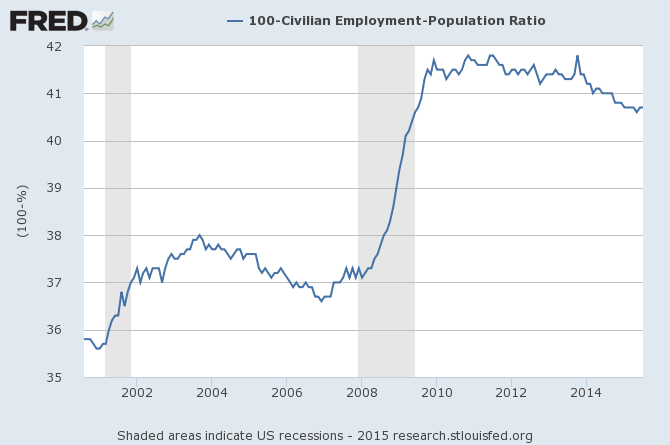
Diamond is right that this is not the best measure of unemployment. Trump's measure includes children, the disabled, and retired senior citizens who don't work for reasons that have nothing to do with the health of the economy. And Trump understands that too--that's why his unemployment figure is 21 percent, he guessed that half of those who don't work aren't unemployed for economic reasons.
Economists have given this issue a lot of thought which is why we've come up with a very specific definition of "unemployment"--those who want jobs but don't have them--to capture a more meaningful economic indicator. And the flaws with that statistic, which we are well aware of, is why we've come up with tons of alternative measures, like U6. I spend quite a bit of time communicating economics to non-economists, which is why I care enough about this to write a post about it. Non-economists usually aren't aware of these definitional issues and often interpret the headline U3 measure to mean the percent of the population that doesn't have a job. I'm frequently asked how many of the 5.3 percent unemployed are children and retired people (none!) and, when I explain the definition, everyone always want's to know the "real unemployment rate" by which they mean the percentage of people who are non-employed. The US has always been a bit puritanical, and (now that women are part of the workforce) people tend to think of this as a place where almost everyone is working full time--they are usually quite shocked at how large the ratio of non-employed people is, and this is exactly what Trump was playing to.
So, yes, more than 40 percent of the population is not employed. Of those, 37.4 percentage points--over 9 out of 10 of Trump's "unemployed" people--are not in the labor force, meaning that they are not looking for work. They are children, retired senior citizens, the disabled, in prison, going back to school, wealthy enough not to work, and yes, some are "discouraged workers" who would be looking for work but don't think they can find a job. But of those who have a job or looked for one in the past month, 94.7 percent were the former.
Lots of outlets have covered the recent controversy over bitcoin block size, but none of them have really given me much detail on it. So here's my attempt to make sense of it. My single biggest source generally is the bitcoin wiki, and based on my remaining open tabs more specific sources are here, here, here, here, here, here, and here. Also, just for fun, you can monitor new bitcoin transactions in real time here.
I've discussed before how the bitcoin protocol works, but in that discussion I focused on how bitcoin uses cryptography to validate individual transactions. The current debate is about something related but slightly different: how those individually validated transactions propagate into the public ledger when there is no central command to secure that ledger.
When you purchase something with bitcoin, your bitcoin wallet creates a record of that transaction, consisting of to and from addresses along with cryptographic signatures. You upload this record to a payment processor, who is really just some random guy with a computer that is hosting a bitcoin node using the open-source bitcoin software.
Anyone can host a node, provided they have adequate hardware (just an ordinary computer with at least 50GB of hard drive space) and internet connection (ordinary, cable internet service will work). A node consists mostly of a copy of the complete bitcoin block chain, which is the public ledger containing a record of every single bitcoin transaction that has ever happened, which currently is about 40GB worth of data. It's called a block chain because the ledger's contents are broken up into a sequential chain of blocks, where each block contains a hash of the previous block along with records of some transactions. A hash is just a number produced by applying a hash function to some text, where two identical texts always produce the same hash number, and two identical hash numbers had to have been produced by identical text. This allows validation of the block chain: for each block you just apply the hash function to the previous block and compare the result to the hash contained in the current block; if they match, you do the same for the previous block, and so one all the way down the chain until you arrive at the original, first-ever bitcoin block.
So when you send your transaction file to be verified, the node host (ie, a miner) will add it to a block it is currently building. When the node is finished building that block, it pushes it to the bitcoin network, where others also validate it's contents and add it to their block chains. Others can validate the block's place in the block chain by following the chain of hashes described in the paragraph above. If the block's contents are validated (see previous), and the chain of hashes is valid, you are half way to completing the transaction.
There is no minimum number of transactions that the miner can include in the block--the block can be considered complete once the miner has solved a time-consuming proof of work algorithm, which basically prevents spam from being entered into the block chain. That said, there's an incentive to include as many transactions in a block as possible, since you get fees on each transaction, but only solve the difficult problem once. But there's a limit: blocks are limited to at most 1MB, or roughly 2,400 transactions.
So once this is pushed to the network, other nodes all check to see that it is valid by checking that the solution to the proof of work is correct, checking that the hash chain goes all the way back to the original block, and finally checking that that hash chain is the longest of all possible hash chains (by convention, they all agree to honor only transactions along the longest chain--this prevents double-spending). But an issue can arise here. If two miners are building blocks at the same time, and try to push them to the network, chances are that they'll both contain a hashed reference to the same parent block since the other has not yet been published--the block chain is forked. So at most one of these can become part of the longest chain, and the other is invalidated--all of the transactions that the other one contained must be added to another block and the whole process must be tried again, until those transactions become part of the longest chain. Only after enough nodes have recognized that a transaction is part of the longest chain does it finally become valid.
Note that we have two constraints: first, the network limits how fast blocks can be added both by rejecting simultaneous additions and by adjusting the difficulty of the proof of work algorithm so that a block can be added only about once every 10 minutes. Meanwhile, each block can contain only about 2,400 transactions because of the 1MB limit. Thus there exists an effective upper bound on how fast transactions can be added to the block chain at about 4 transactions per second, perhaps considerably less when other factors are considered. And that's where the block size debate comes into play. According to this guy's calculations, we'll probably reach that upper bound in 2016 or 2017, probably causing transaction fees to spike as the market rations bitcoin transactions. One way to increase the capacity of the network is simply to increase block size and with it, the number of transactions that can be added per block. This would mean that the block chain file would grow more quickly, perhaps increasing hardware and network requirements for hosting a full node. On the other hand, it would also mean more revenue from mining, without necessarily increasing transaction fees.
But that is not the only way the network can expand capacity. In my view, the likely outcome of failing to increase block size is increased centralization and the emergence of Bitcoin Banking. In fact, you don't need a formal transaction entered on the block chain for control of a bitcoin to change hands. The way a Bitcoin Bank would work is this: you have bitcoins and deposit them at a bank (or, more cheaply, you buy bitcoins through the bank). Then the bank would maintain an off-network block chain as you spend those bitcoins, and at the end of each day would merge it's off-network chain with the official block chain. But if it is sufficiently large, it can consolidate considerably. For example, instead of a separate transaction every time one of the bank's customers spend coin at Kroger, it could simply have one transaction for the full amount all its customers spent at Kroger. This would represent a massive consolidation in the number of transactions, number of blocks required, and therefore the amount in transaction fees. In a world where transaction fees are high (and most bitcoin transactions are legal/legitimate), I think this kind of centralization is inevitable.
But then, centralization might be inevitable anyway. A centralized off-network block chain administered by a trustworthy bank doesn't require all of the resource-consuming proof-of-work and decentralized network verification, and thus is inherently lower cost regardless of the maximum block size of the main bitcoin block chain. To the extent that people want to use bitcoin at all, there is an arbitrage opportunity for any trust worthy institution to centralize it. Economics tells me that arbitrage moves markets.